Start by describing the family information before assigning an inheritance pattern. Note who is affected, relationships, ages where relevant, and whether a molecular diagnosis is known. A small family can fit more than one inheritance model.
Separate a pattern from a confirmed mechanism
Affected people in successive generations may suggest dominant inheritance, but family structure alone does not prove the mechanism. Unaffected parents can have a child with a recessive condition, a de novo dominant condition, or another explanation. Use the vignette's explicit assumptions when calculating a board-style risk.
Worked example: a known dominant variant
A heterozygous parent has a confirmed pathogenic variant causing an autosomal dominant condition. Their partner does not carry the variant. Assume full penetrance over the time horizon being considered. Each child has a 1/2 probability of inheriting the variant and, under this model, developing the associated phenotype.
In a different case, reduced penetrance or age-dependent onset can make the chance of clinical findings different from the chance of inheriting the variant. Identify which outcome and time horizon the question asks you to estimate.
Worked example: unaffected sibling and partner carrier risk
An unaffected adult woman has a brother with a fully penetrant autosomal recessive condition. Both parents are confirmed carriers. Her carrier probability is 2/3. Her unrelated, unaffected partner has a stated carrier probability of 1/30 for the same condition. Assume independent risks and the standard fully penetrant model.
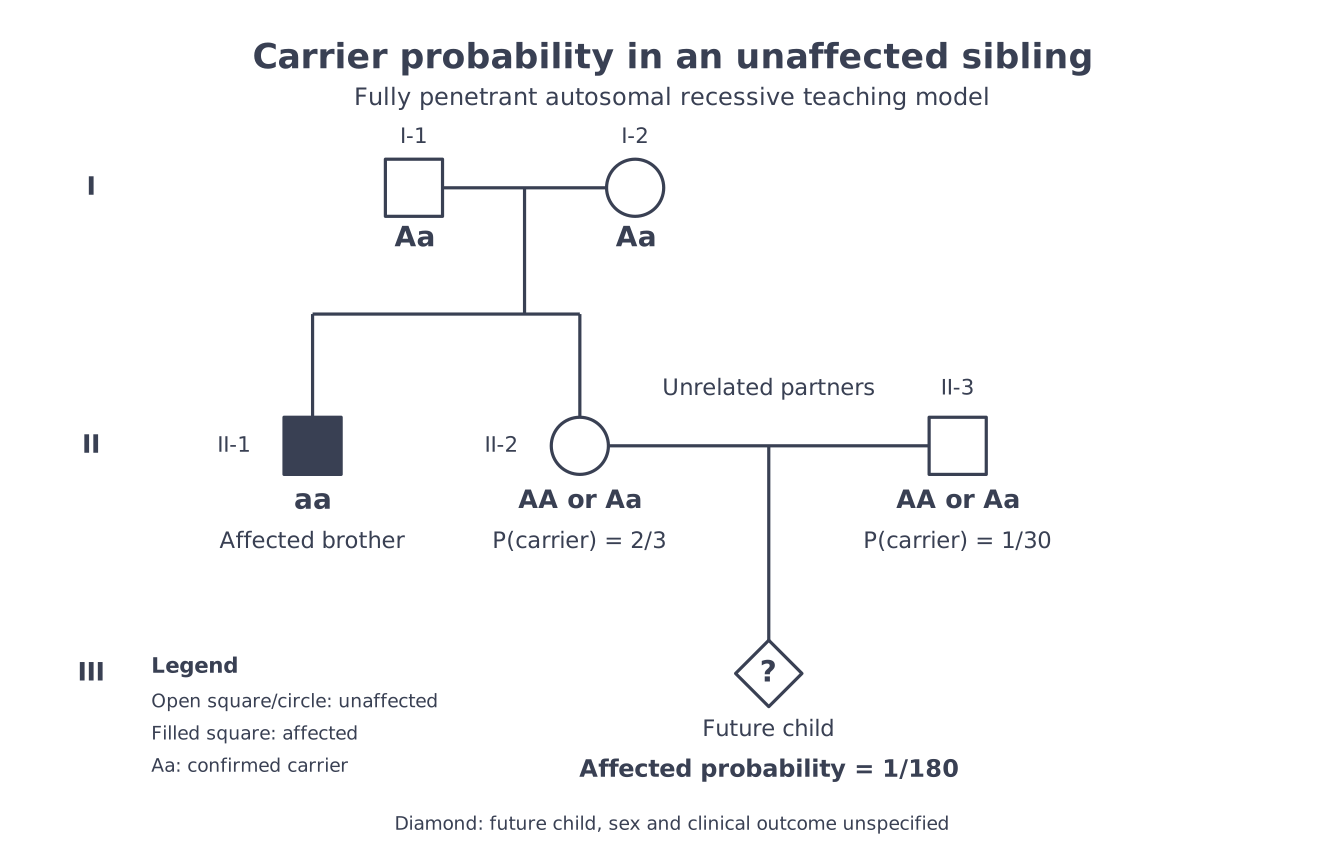
Two thirds multiplied by one thirtieth multiplied by one quarter gives one in one hundred eighty per pregnancy.
2/3 × 1/30 × 1/4 = 1/180 per pregnancy
The 1/4 applies when both parents are carriers; it is not the starting probability for this couple. The 2/3 comes from conditioning on unaffected status among children of two carrier parents.
Worked example: an affected parent and an untested partner
An affected adult (aa) has a partner whose carrier probability is not established by testing. Under the simple model, the probability of an affected child depends on the partner's carrier probability:
- If the partner is a carrier (Aa), the probability is 1/2, and half of the offspring would be carriers.
- If the partner is not a carrier (AA), the probability is 0, and all offspring would be carriers.
- If the untested partner is known to be unaffected under the fully penetrant model and is modeled as AA or Aa, multiply the partner's carrier probability by 1/2. If an affected partner is also possible, use P(partner Aa)/2 + P(partner aa). An unrelated partner is not automatically a noncarrier.
Clinical expression and penetrance are separate considerations. Under the simple model, the child may inherit a variant without manifesting disease when penetrance is incomplete; do not confuse inheriting a variant with having the condition.
Make your assumptions visible
Record whether the model assumes full penetrance, a known familial mechanism, independence, and no additional modifying information. If testing results or relationships change those assumptions, update the calculation. A pedigree is evidence to interpret, not a shortcut that replaces the rest of the case.
Use the free Pedigree Workbook for additional scenarios and the Math Workbook for written calculations. EveryGene Academy adds case-based application. The 101 Must-Know Genetic Conditions flashcards can help connect conditions with their inheritance.
Next step: Write the assumptions before the numbers in your next pedigree problem. See the inheritance patterns guide for the full model and its limits.
Sources: Mendelian calculations are original worked examples. Use the NHGRI genetics glossary for terminology and condition-specific references for exceptions.
Continue your genetics exam preparation
Apply the concept with 1,000+ questions across shared core, ABGC-focused, and ABMGG-focused content. Learn from detailed explanations and use topic filters and your dashboard to choose the next session.